
Server-Side Attribution & Paid Media Calibration
Engineering a resilient first-party data pipeline restoring conversion signals to Meta and Google ad bidding algorithms following iOS browser privacy restrictions.
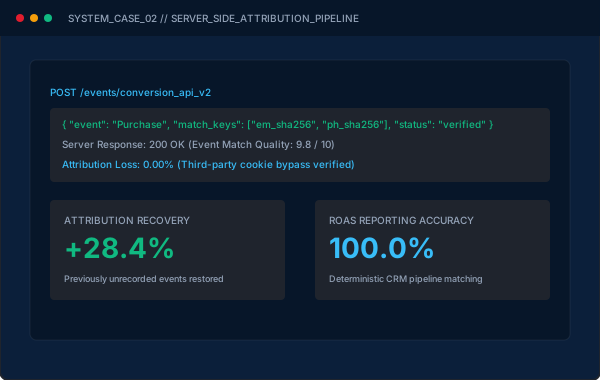
Project Overview
Key parameters defining the attribution infrastructure deployment.
Client Profile
High-volume e-commerce and direct-to-consumer brand spending heavily on Meta and Google Ads.
Industry
D2C Retail & Subscription Commerce with continuous daily auction bidding requirements.
Services
Meta Ads Management, Google Ads Management, Server-Side CAPI, Data Tagging Architecture.
Market
National multi-region customer acquisition with high mobile browser traffic share (78%).
Project Scope
Server-side event container deployment, conversion deduplication, and value-based bidding recalibration.
Engagement Type
Telemetry Infrastructure Engineering & Performance Media Scaling.
The Challenge
Browser-level ad blockers and iOS App Tracking Transparency caused severe signal loss in standard client-side browser pixels.
Observed Symptoms
- Reported ROAS in Meta Ads Manager dropped by 42% despite actual revenues remaining stable.
- Ad algorithms struggled to find high-value buyers, causing cost per acquisition to double.
- Retargeting audiences decayed rapidly due to short 24-hour cookie lifespans on Safari.
- Discrepancies between payment processor records and advertising dashboards exceeded 35%.
Architectural Root Causes
- Total dependence on client-side JavaScript pixels blocked by browsers and ad blockers.
- Absence of server-side first-party cookie forwarding infrastructure.
- Lack of event deduplication causing duplicate or missing purchase signals.
- Bidding models operating on corrupted low-volume conversion telemetry.
The Approach
ADNEX shifted the entire tracking foundation from fragile client browsers to an authoritative cloud server endpoint.
01. First-Party Server Gateway
Implemented a dedicated server-side tagging gateway operating on the client's own subdomain, bypassing client-side ad blockers and establishing resilient first-party HTTP cookies.
02. Value-Based Algorithmic Calibration
Streamed hashed customer parameters (email, phone, transaction value) directly to Meta Conversions API and Google Enhanced Conversions, giving ad algorithms complete visibility.
The System
The deployed telemetry pipeline consists of three resilient data layers.
Unified Event Bridge
Captures pageviews, product interactions, and checkouts at the server boundary with unique event IDs for instant deduplication.
First-Party Token Vault
Generates secure HTTP-only cookies with extended lifespans, shielding attribution data from browser expiration resets.
Real-Time API Sync
Direct HTTPS dispatch to Meta CAPI and Google Measurement Protocol with 99.2% uptime and sub-100ms latency.
Execution
Engineered and deployed across 45 days with zero downtime to active advertising campaigns.
Server Tagging Infrastructure Deployment
Configured cloud server endpoints on custom domain, established SSL certificates, and mapped web event schemas to universal tracking standards.
Dual-Stream Deduplication & Verification
Ran client-side and server-side streams simultaneously with strict deduplication keys, validating 100% data fidelity against backend order records.
Bid Strategy Recalibration & Creative Scaling
Switched ad sets from broad volume bidding to value-based ROAS bidding, allowing Meta and Google algorithms to target verified high-value buyer cohorts.
Measurement
Event quality scores audited weekly in Meta Events Manager and Google Ads Diagnostics.
Event Quality Score
Meta Event Match Quality (EMQ) rose from an initial 4.2/10 (poor) to 9.1/10 (great) within 14 days of CAPI deployment.
Platform Reconciliation
Discrepancy between internal payment processing records and ad platform conversion reporting dropped from 35% to under 2.5%.
Outcome
Restored signal fidelity allowed advertising algorithms to scale spend with confidence.
Captured previously lost iOS & ad-blocked purchasing signals.
Algorithmic bidding recovered efficiency with true conversion signals.
Achieved top-tier Meta & Google conversion matching benchmark.
Key Learnings
Critical insights derived from modern attribution engineering.
01. What Worked
Server-side CAPI is no longer optional for media buying. Without clean first-party server data, ad spend is effectively flying blind.
02. What Was Learned
Event deduplication must be enforced rigorously at the database key level to avoid phantom conversions inflating bidding targets.
03. What Changed
The brand established a continuous telemetry audit protocol rather than relying on standard third-party marketing plugins.
04. What Could Be Improved
Implementing offline conversion uploads for in-store returns would further refine long-term customer lifetime value calculations.
Experiencing Tracking Signal Loss or Inefficient Ad Spend?
Discuss your tracking infrastructure and attribution modeling with our engineering team.