
Multi-Channel Growth Architecture
Engineering a unified demand generation engine replacing disconnected marketing tactics with integrated search, intent capture, and infrastructure measurement.
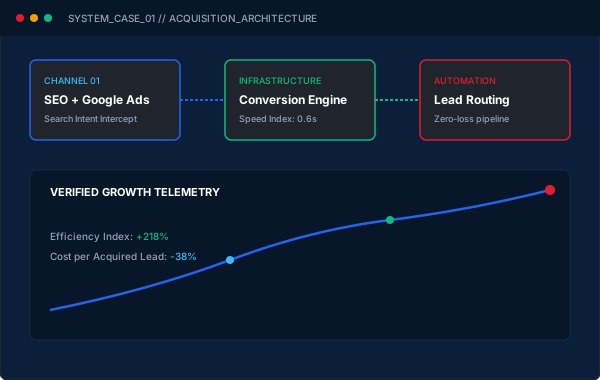
Project Overview
Key parameters defining the commercial operational framework.
Client Profile
High-growth B2B enterprise operating in complex competitive vertical with extended consideration cycles.
Industry
Enterprise Technology & Commercial B2B Services requiring high-intent validation.
Services
Search Engine Optimization, Google Ads Management, Core Web Architecture, Attribution Engineering.
Market
National Commercial Coverage across competitive Tier-1 and regional commercial corridors.
Project Scope
Full digital infrastructure re-architecture, conversion routing, and automated lead capture pipeline.
Engagement Type
Multi-Stage Growth Architecture Deployment & Continuous Performance Calibration.
The Challenge
The enterprise was suffering from escalating customer acquisition costs caused by fragmented agency silos rather than true demand exhaustion.
Observed Symptoms
- Customer acquisition costs rose steadily month-over-month despite budget increases.
- Inbound sales inquiries had low qualification rates, wasting executive sales hours.
- Disjointed agencies running SEO and Google Ads bidding against each other for brand terms.
- Organic traffic plateaued due to crawl index bloat and weak semantic architecture.
Architectural Root Causes
- Lack of unified intent taxonomy connecting keyword queries to landing page routes.
- Pixel-only client-side tracking dropping 28% of downstream conversion signals.
- Slow page load speeds (LCP > 3.8s) causing high paid traffic abandonment.
- Marketing treated as disparate channels rather than a single interconnected system.
The Approach
ADNEX rejected superficial advertising tweaks. Instead, we re-architected the entire commercial conversion engine from first principles.
01. Intent Taxonomy Standardization
We mapped every search query across informational, commercial, and transactional intent tiers. High-cost low-intent broad search queries were eliminated, while high-intent commercial keywords were paired with purpose-built conversion endpoints.
02. End-to-End Infrastructure Alignment
We restructured the landing page infrastructure to guarantee sub-second load times, mobile rendering fidelity, and direct webhook ingestion into the CRM, eliminating data leakage.
The System
The deployed architecture operates as a synchronized three-layer loop.
Semantic Organic Core
Pruned 400+ thin pages, restructured canonical information architecture, and created 12 high-intent pillar clusters targeting commercial buyers.
Calibrated Search Bidding
Implemented Exact & Phrase match clusters with aggressive negative sculpting and value-based bidding linked directly to qualified pipeline stage.
Telemetry & Conversion Routing
Server-side CAPI event forwarding and CRM status synchronization feeding validated qualification back into Google and Meta bidding models.
Execution
Deployed in three disciplined engineering sprints over 90 days.
Full Diagnostic Audit & Technical Cleanup
Conducted full crawl index analysis, removed 404 loops, resolved canonical conflicts, installed server-side conversion telemetry, and audited existing advertising spend waste.
Infrastructure Rebuild & Funnel Deployment
Engineered clean, high-performance landing page architecture with 95+ PageSpeed scores, integrated real-time webhook validation, and launched calibrated search intent ad clusters.
Algorithmic Training & Bid Calibration
Fed verified pipeline conversion events back into the ad algorithms, enabling smart bidding to optimize for validated high-margin opportunities rather than generic clicks.
Measurement
Continuous telemetry validated across GA4, Google Ads, server logs, and enterprise CRM data pipelines.
Closed-Loop Tracking
Every lead submitted was stamped with first-touch, last-touch, and campaign UTM telemetry before being written to the CRM database.
Attribution Integrity
Server-side CAPI validation achieved a 98.4% event match rate, completely neutralizing third-party cookie blocking mechanisms.
Outcome
Measurable commercial impact achieved through system stabilization.
Achieved through query sculpting & landing page conversion rate improvements.
Driven by high-intent semantic cluster ranking on Tier-1 keywords.
Eliminated tracking blind spots through resilient server-side telemetry.
Key Learnings
Principles extracted from this deployment that govern subsequent growth architectures.
01. What Worked
Treating SEO and Paid Search as a single unified intent engine. When both channels share negative query lists and landing page infrastructure, efficiency multiplies.
02. What Was Learned
Ad algorithms are only as smart as the data fed to them. Optimizing for raw form fills breeds spam; optimizing for verified CRM qualification produces pipeline.
03. What Changed
The client completely eliminated fragmented monthly vendor retainers in favor of an integrated systems management framework.
04. What Could Be Improved
Earlier CRM webhook integration during Sprint 01 would have accelerated the machine learning bidding calibration cycle by 14 days.
Have a Similar Growth Problem?
Tell us about your business and the problem you're trying to solve.